
Provo Records Open to the Public
Provo is Utah County's seat, so city borders do not define the records system. The city recorder handles municipal files. County offices keep deeds, ownership data, taxes, marriages, and elections. Utah Courts controls district and justice case information, while county and state health offices issue certificates. Access also depends on the record itself. A deed index may be open online, but a recent birth certificate is limited by relationship and legal authority.
| Record set | Responsible custodian | Web access | Access route |
|---|---|---|---|
| Deeds, mortgages, liens, plats | Utah County Recorder | Land Records, searchable abstract from 1985 | Free library; counter help for older work |
| Property, value, and tax | Recorder, Assessor, Treasurer | Owner, address, serial, GIS, and tax modes | Free portal; office or GRAMA fallback |
| District and justice cases | Utah Courts | Xchange statewide repository | Paid online; free public terminals |
| Birth and death certificates | Utah County Health and Utah OVRS | Order channel, not a broad name index | Eligibility and ID until aging limits expire |
| Marriage and divorce | County Clerk, Fourth District Court, OVRS | License search or case search by custodian | Copy rules differ by document |
| Jail and state supervision | County Sheriff and Utah Corrections | Separate current-status searches | Free tools; agency request fallback |
Sealed or expunged cases, juvenile matters, adoption files, protected domestic-case material, at-risk voter files, and recent vital certificates are not made open merely because a request cites GRAMA. A custodian can redact a restricted part and release the part that remains public.
Provo Recorder Indexes Since 1985
The Utah County Recorder's official service leads to a free library of land documents, maps, abstracts, and images. Its office records instruments and supplies plain or certified copies, but staff do not prepare documents, interpret title, give legal advice, or conduct research by phone. The online property abstract is fully searchable from 1985 forward. Earlier chains may require the counter, scanned abstract resources, 1976 and 1977 REDI books, the Utah State Archives, or FamilySearch.
The captured Utah County Recorder page is the source a Provo researcher should confirm before relying on a copy.
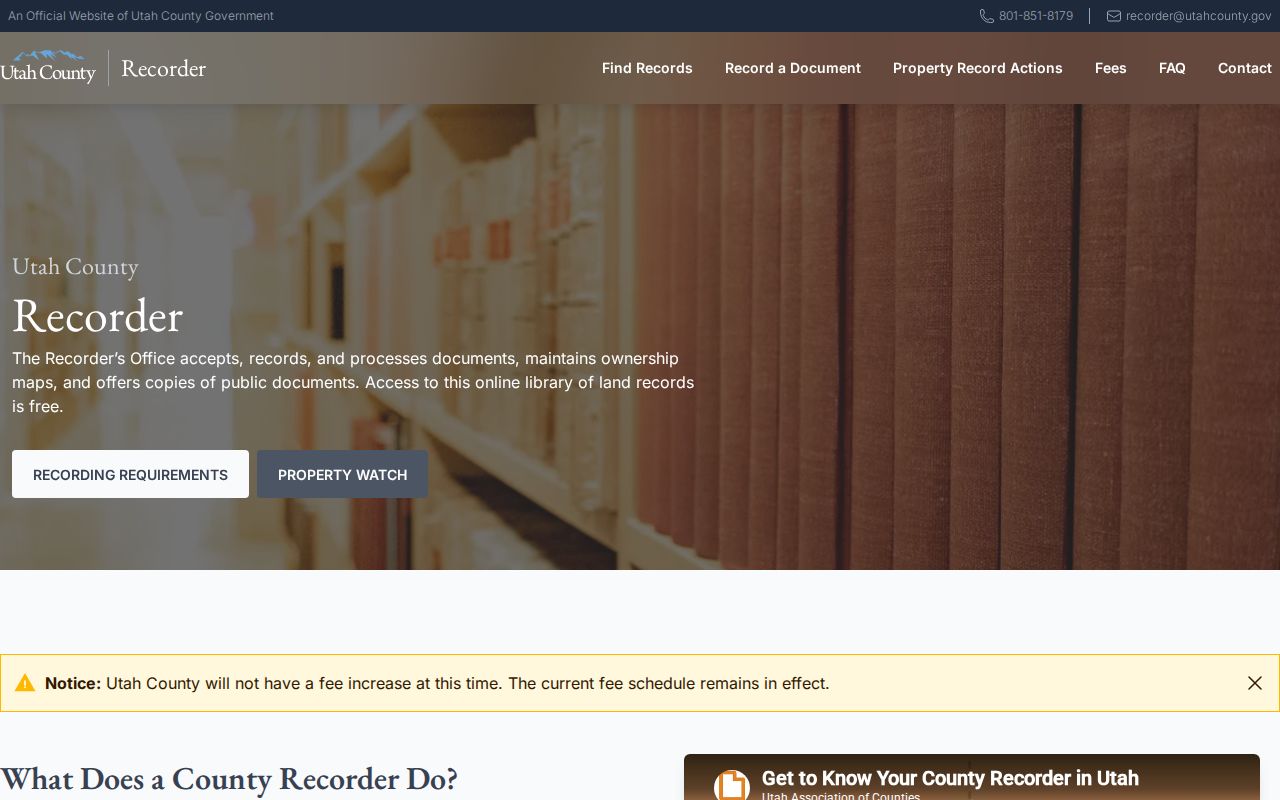
The office page links free access with the contact fallback needed for material outside the modern index.
Searches can begin with an owner name, street address, nine-digit parcel serial, party name, entry, book and page, subdivision, or legal-description elements. Party searching can also narrow a surname by kind of instrument, such as conveyance, judgment lien, mortgage, release, plat, power of attorney, or zoning.
Provo Records Entry Search Fields
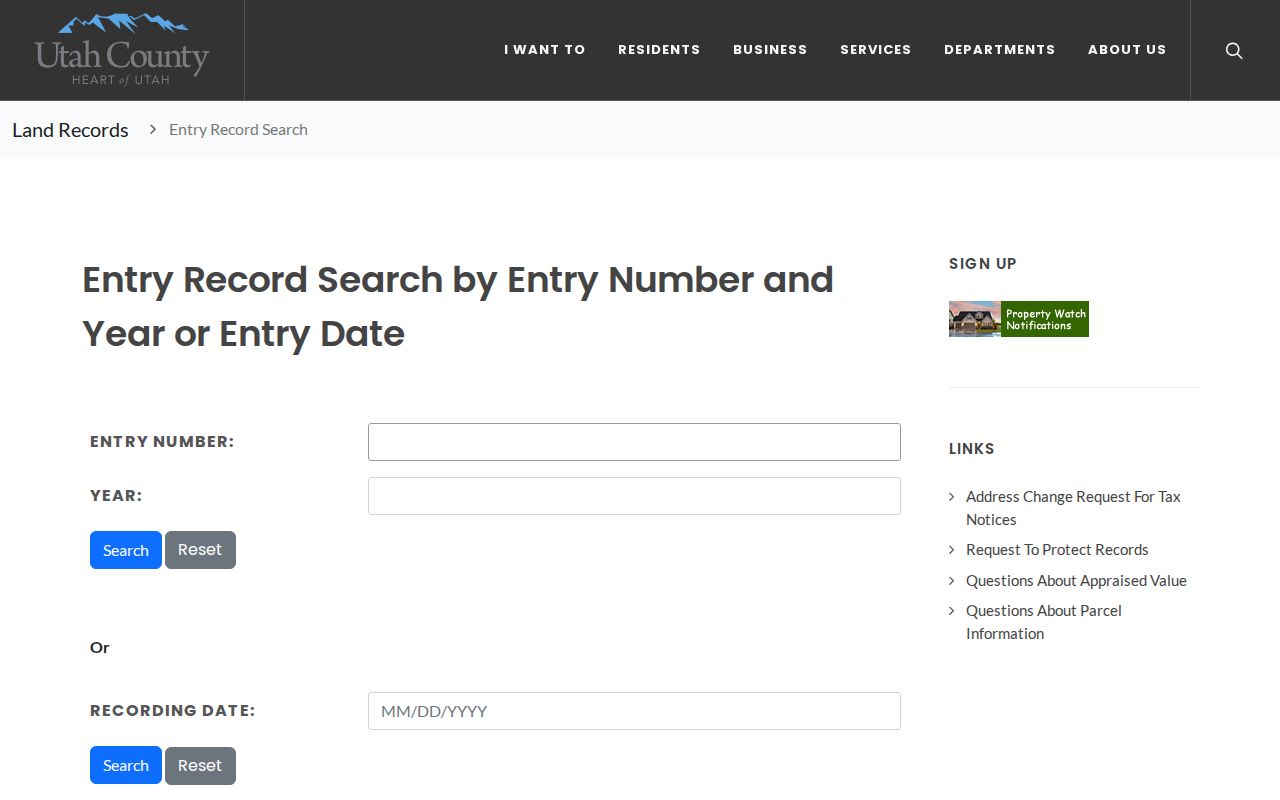
An entry number is the Recorder's identifier for a filed instrument. It is more precise than a common name and can take a search directly to the matching year. Recording dates offer another route when an entry number is unknown.
| Field or control | Type | Required | Format or purpose |
|---|---|---|---|
| Entry Number | Text | With year | Numeric document entry |
| Year | Text | With entry | Recording year paired to entry |
| Recording Date | Date | Alternative | Find entries recorded on a date |
| Search | Button | No | Runs the selected lookup |
| Reset | Button | No | Clears the form |
The Recorder entry search displays these compact controls.
A result can show parcel serial, entry and year, kind-of-instrument code, grantor, and grantee. Grantor means the party transferring an interest; grantee means the party receiving it.
- Index
- A finding aid that points to a record; it is not always the full document.
- Image
- A scanned view of the filed instrument linked from an index entry.
- Certified copy
- A copy authenticated by the office for a formal use.
- Custodian
- The government office responsible for maintaining and releasing a record.
- Exemption
- A law-based reason to withhold all or part of a government record.
Provo Court Records and Xchange
Utah Courts Xchange covers public district and justice case summaries statewide. Fourth District Court keeps Provo probate, divorce, felony, and general civil files. Provo Justice Court handles Class B and C misdemeanors, infractions, traffic matters, and small claims. The Utah County Clerk is not the district-court clerk.
The online system accepts a party or company name, court scope, case type, date range, case number, and other filters. An asterisk in the first-name field can return variants and middle initials. Results may include the court, filing date, party role, case history, public orders, events, charges, dispositions, and counsel. Sealed, expunged, juvenile, adoption, and other protected matters do not appear.
Online access has search and document charges. Free Xchange terminals are available at most district courthouses and the Utah State Law Library. A clerk can also handle a copy or audio request when the case number and correct court are known. Historical court series move to the Archives, while federal cases use PACER rather than Xchange.
Access choice. A courthouse terminal avoids Xchange online search charges, but any requested copy can still carry the court's applicable fee.
Provo Certificate Access Has Limits
A certificate order is not the same as an open index. Utah birth certificates become public after 100 years, and death certificates after 50 years under Utah Code §26B-8-125. Before those points, the subject, qualifying relatives, guardians, legal representatives, or applicants with statutory interests must show identity and, when needed, proof of relationship.
Utah County Health accepts birth and death applications at its Provo counter and by mail. A mailed application needs an enlarged copy of acceptable identification. State OVRS also takes certificate orders, with mail processing listed at six weeks or more. Historical research can shift to Archives indexes and images, cemetery records, newspapers, church sources, and the library once the applicable access threshold has passed.
The Utah County birth and death certificate page shows the local ordering route and applicant rules.
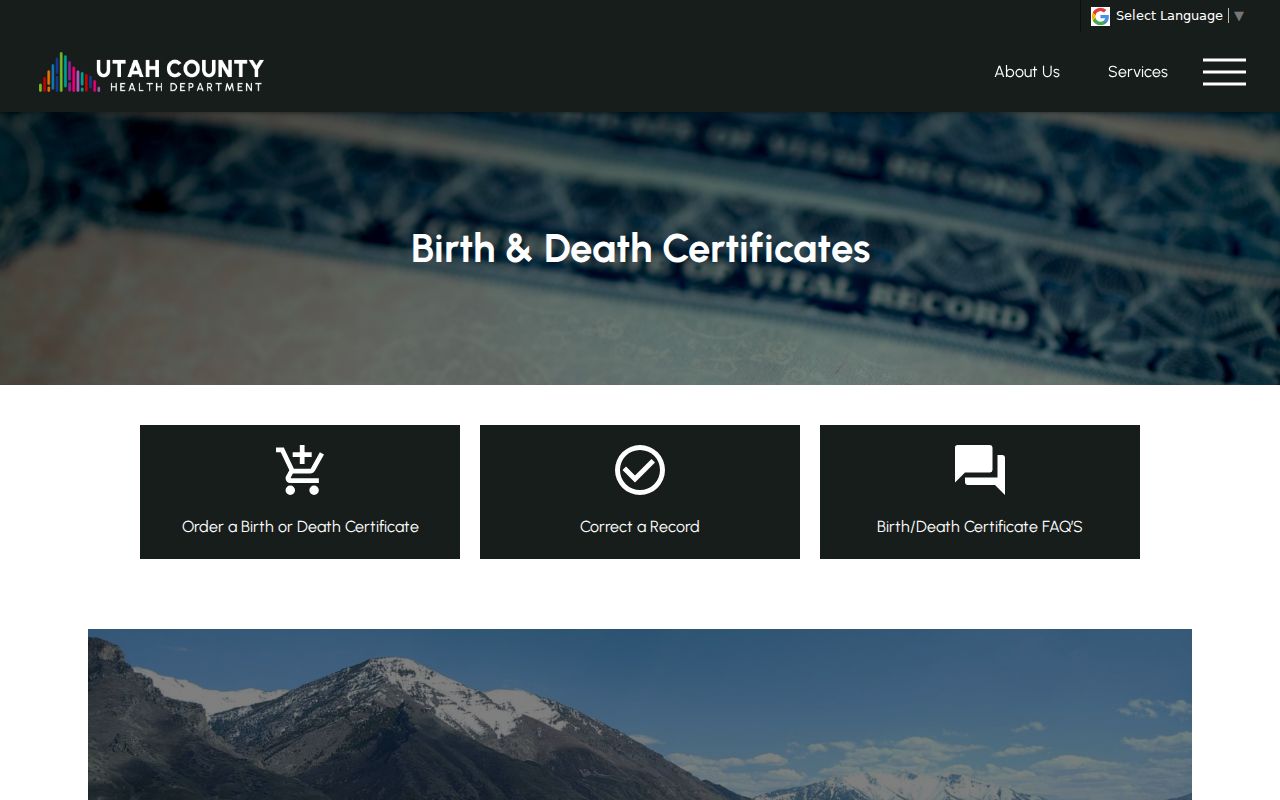
The local source makes clear why an order form, identification, and eligibility proof replace a casual name search.
Provo Marriage and Divorce Records
Marriage and divorce documents split across custodians. The Utah County Clerk keeps marriage licenses and offers a name search to identify the license number. A certified paper marriage copy costs $10 plus the stated card fee. Orders are limited to spouses or someone with a direct, tangible, legitimate interest. Counter orders with identification generally take about 10 to 15 minutes; mail and online routes are also documented.
Fourth District Court holds the divorce decree, pleadings, and case history. OVRS maintains a statistical marriage or divorce certificate system for later events beginning in 1978, but that certificate is not the court decree. Court privacy rules may close parts of a domestic case even when a public history, hearing, order, or letter of appointment remains available. Choosing the document first prevents a request from going to the wrong Provo office.
Note: Adoption records use protected registry and court routes; ordinary GRAMA does not open a sealed adoption file for family research.
Provo Public Records Custodian Offices
Three Provo counters resolve much of the city-county split. The Recorder handles land instruments. The City Recorder receives municipal GRAMA requests. Fourth District Court controls its own case files. Calling the office can be useful when an old volume, copy format, or case identifier does not appear online.
Utah County Recorder
100 East Center Street, Suite 1300
Provo, UT 84606
801-851-8179
Monday-Friday, 8:30 a.m.-5 p.m.
Provo City Recorder
445 West Center Street, Suite 410
Provo, UT 84601
801-852-6524
Monday-Thursday, 7 a.m.-6 p.m.
Fourth District Court
137 North Freedom Boulevard
Provo, UT 84604
801-429-1000
District, probate, and court-file access
Utah County Health is at 151 South University Avenue, Suite 1100, with different Wednesday opening hours from the rest of its workweek. The County Clerk's marriage office is at 111 South University Avenue. Each has its own eligibility and copy process rather than a shared county request desk.
Provo City Records Take Separate Routes
City permits, administrative files, and many municipal records go to the Provo City Recorder, not the county. A request must seek an existing record. It is not a way to ask a general question or require staff to create a new analysis. Police and Fire materials have separate choices within the city process, and frequently available material may already be in the city's transparency resources.
The Provo GRAMA request page is the official municipal starting point.
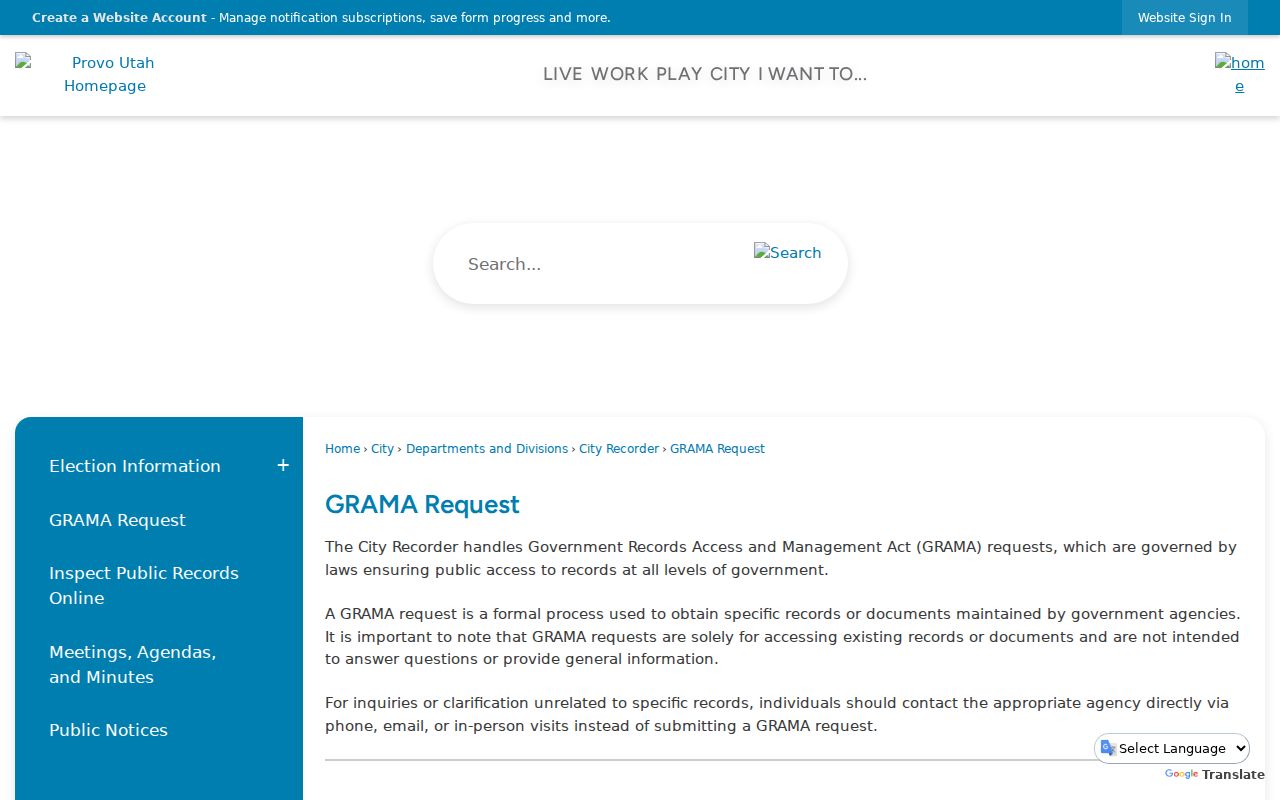
The city route keeps municipal requests distinct from county deeds, court cases, and state certificates.
Published city charges include $10 for a traffic-accident report, $10 for a police clearance or insurance letter, $20 for a photo CD, $5 for a printed photograph, and a $25 video minimum credited toward the final fee. Police and Fire record work has a $15 minimum credited toward the final fee. Ask for an estimate when the scope may require staff time.
Provo Records Follow Real Boundaries
A postal address that says Provo does not prove the parcel lies within city limits. Provo Canyon districts and nearby county land can share place labels that do not settle municipal jurisdiction. The county parcel map provides the better check before a city filing. Its search accepts an address, parcel serial, owner name, land-survey section, or city zoom, then adds boundaries and map layers.
The same distinction matters inside a parcel result. Situs means the land's physical location. An owner's mailing address is a tax or contact address and may be elsewhere. A legal description identifies the land in the recorded instrument, while the tax description is not meant for legal documents. Some small, agricultural, or poorly described parcels have no street address at all.
Note: The parcel viewer's Historic Parcel date reflects entry into the online property system, not necessarily the deed's recording date.
Provo Custody Records Need Two Searches
The Utah County Sheriff search covers county bookings and current inmates, while the Utah Department of Corrections tool covers current state incarceration, probation, or parole. Neither is a complete criminal-history source. A no-result can reflect release, another county, federal custody, a short retention window, spelling, or a legal restriction.
The county tool searches a name, an arrest date, or current inmates. It warns that booking can take 24 hours to appear. Its descriptions conflict on whether some remaining booking data spans one or two years, and a booking photograph may disappear after about 30 days. That conflict should be checked at the source rather than turned into a firm coverage promise. VINE offers separate status notifications, and the official registry has its own terms.
Provo Deed Alerts After Recording
Utah County Property Watch sends email when a deed, lien, or other document is recorded against an enrolled parcel. It is free and useful for noticing a new filing. It does not confirm title, block a document, or replace review of the actual instrument.
Enrollment starts at the official Property Watch service. A notice should lead back to the Recorder's index and image, where the entry, year, parties, instrument type, and parcel cross-reference can be checked. Questions about an unfamiliar document go to the Recorder at 801-851-8179. A large private deed-copy invoice should also be compared with the county's free online library and official copy charges.
Requesting Provo Public Records Under GRAMA
Utah's Government Records Access and Management Act, Utah Code Title 63G, Chapter 2, supplies the written route when an ordinary portal or copy service does not provide the record. The ordinary response is as soon as reasonably possible and no later than ten business days. A supported request showing a public benefit can use the five-business-day track. Extraordinary circumstances may extend the production date.
- Choose the custodian. Send city files to Provo, deeds to the Recorder, marriage or election material to the County Clerk, court files to the court, and certificates to Health or OVRS.
- Search first. Keep any parcel, entry, case, license, or certificate identifier that narrows the request.
- Describe existing records. Give the record type, people, date range, identifiers, desired format, name, mailing address, and available contact details.
- Use the custodian's channel. Submit through its portal, email, mail, or counter. The state portal serves many state agencies, while local entities use local routes.
- Review cost and response. Ask for electronic output and an estimate. Inspection alone is free unless statutory access costs apply, and the first quarter-hour of staff time is free.
- Appeal a denial. The denial should state its classification, legal basis, and appeal route. An appeal generally goes to the chief administrative officer within 30 days.
The Utah Open Records Portal shows the state-agency submission and tracking route.
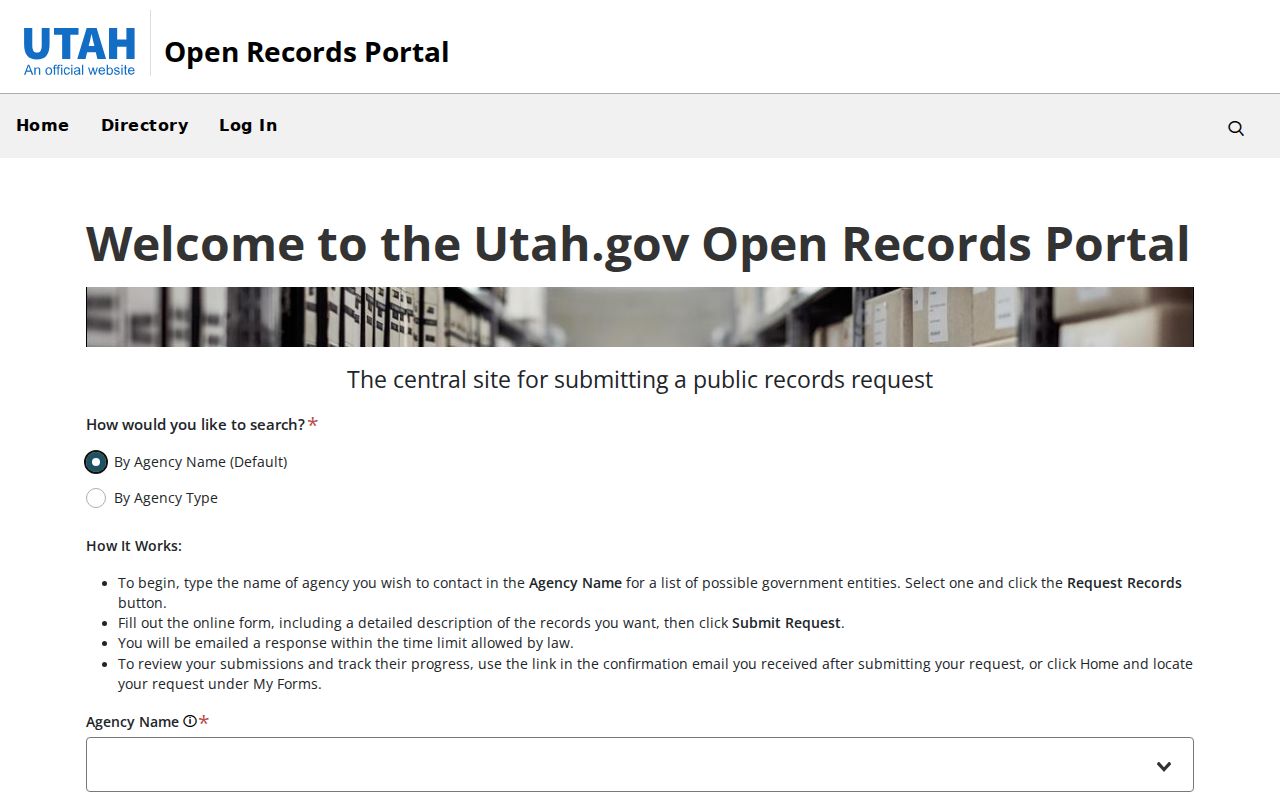
The portal complements local forms; it does not turn every Provo, county, or court request into a state filing.
Lawful personal use. Open access never authorizes stalking, threats, impersonation, or harassment. Verify a record with its custodian and respect every statutory restriction.