
Check Provo Voter Registration
Utah's official lookup is a personal verification tool, not a directory for browsing everyone with the same surname. A Provo voter must supply details that match the voter registration record. JavaScript and reCAPTCHA must also work in the browser. Begin at the Utah Voter Registration Portal, choose the voter-information search, and enter the registered details rather than a nickname or former address.
| Lookup entry | Input kind | Needed | How to complete it |
|---|---|---|---|
| First Name | Text | Yes | Use the registered given name. |
| Last Name | Text | Yes | Use the registered surname. |
| Date of Birth | Masked date | Yes | The date must match the record. |
| Street Address | Text | Yes | Enter the current registered residence. |
| City | Text | Yes | Enter the registered city. |
| ZIP | Masked text | Yes | Use ZIP format. |
| reCAPTCHA | Challenge | Yes | Complete the anti-automation check. |
| Submit | Button | No | Runs the personal match. |
The alternate address search needs the street, city, and ZIP, but leaves out name and birth date. A failed search may mean a typing error, an old registered address, or no current registration. It does not prove that a person never registered. Check each value, then ask Utah County Elections to resolve a nonmatch or update an address.
The personal voter information form shows the exact fields a Provo voter must complete.
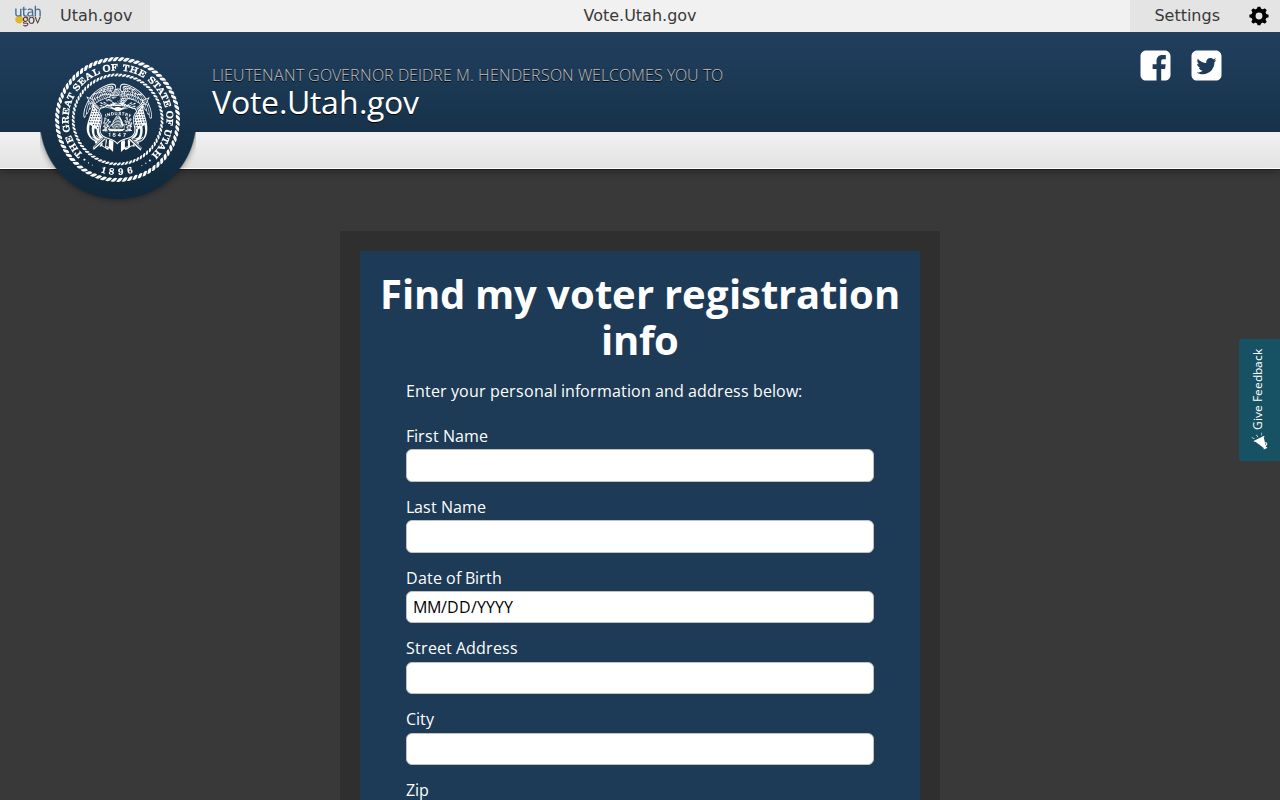
Its field set makes the boundary clear: this route verifies one person's record and does not support a loose name-only search.
Provo Voter Match Results
A successful personal match can return the physical street and unit, city, state, ZIP, precinct, State House district, voter ID, party affiliation, and active or inactive status. Election, polling, and ballot-status details may also appear. Ballot status concerns the ballot process. It never reveals how a person marked a ballot.
The state registration portal is also the official starting point for Provo voter registration checks.
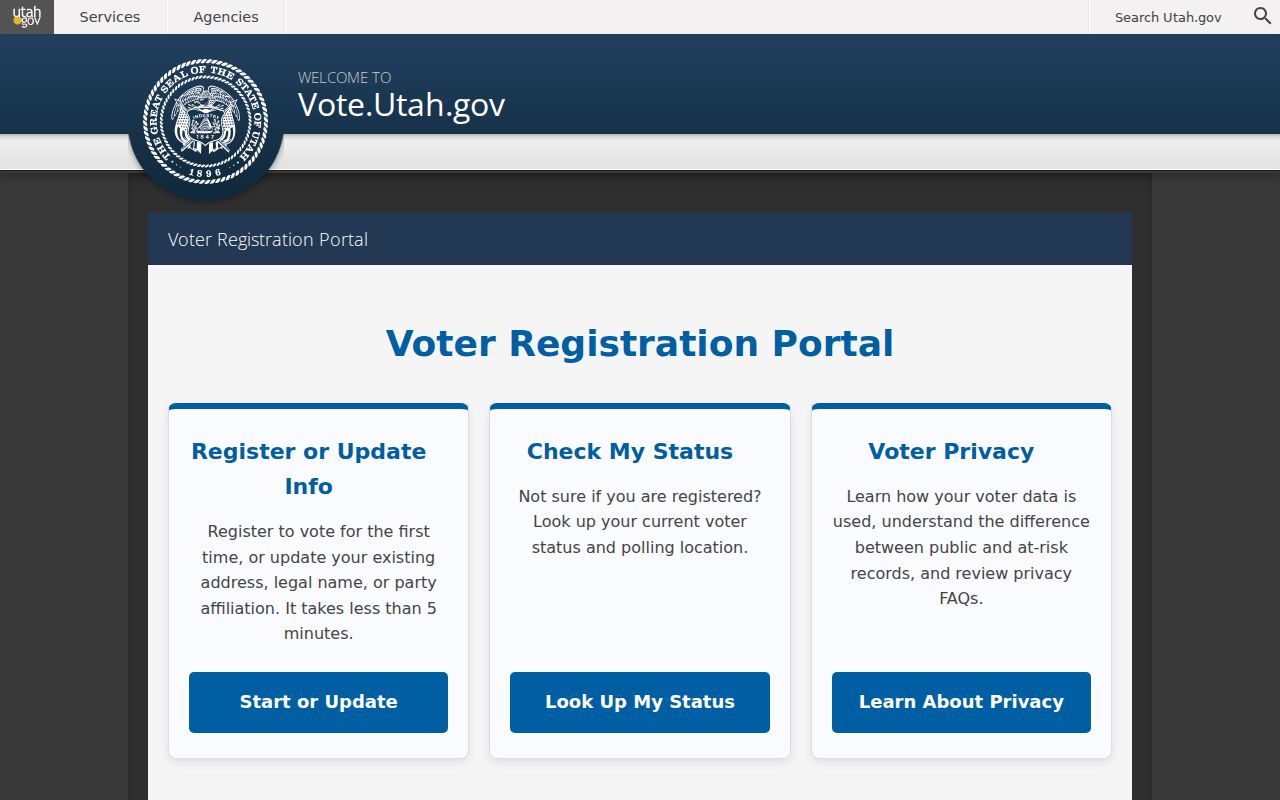
The portal groups registration, status, and election tools while keeping access tied to the voter's identifying inputs.
Use the date shown with any result. Provo has many people who move often, so an old address can explain a mismatch. The personal portal is best for checking one's own registration and election logistics. It is not the right channel for a statewide voter file.
Utah Voter Records Fields
Utah Code §20A-2-601 defines the standard voter data that may be disclosed for an allowed purpose. It is broader than a personal portal result. The statewide file links identity, residence, districts, status, and recent participation. It does not expose ballot choices. An age range replaces a full birth date in standard data.
| Identity | Full legal name, voter ID, FIPS code, county, and age range. |
|---|---|
| Addresses | Complete residence and unit plus mailing address and city, except for at-risk voters. |
| Election geography | Precinct and congressional, legislative, school-board, county-council, and city-council districts. |
| Affiliation | Political party or unaffiliated status. |
| Participation | Eight years showing whether the voter took part, never the voter's choices. |
| Record status | Active or inactive status and the last update date. |
Age ranges begin with narrow groups for younger voters and broaden later. That can help distinguish two voters with the same name without releasing a precise birth date. A participation entry confirms only that a person voted in an election. Secret ballot choices remain secret.
Provo Voter Privacy Lines
Not every item on a registration application enters the standard file. Utah treats driver-license or state-ID information, Social Security number data, email, full date of birth, citizenship proof or indicator, and a federal-ballot-only indicator as private under GRAMA §63G-2-302. A signature cannot be copied. A custodian may allow in-person viewing of a signature that is not otherwise private.
Confidential by law. Under Utah Code §§20A-2-601 and 20A-2-606, an at-risk voter's whole record, application, and supporting proof are private, not merely the street address.
The at-risk classification covers qualifying victims of domestic or dating violence, threatened people, certain protected officials and service members, people with qualifying protective orders, and some household members. The county clerk checks the evidence and later reviews continued eligibility. Utah's separate Address Confidentiality Program can provide a substitute address to qualifying survivors. A person may need both protections because they serve different roles.
2026 Rules for Provo Voters
Older Utah County prose may describe voter registration categories that changed on May 25, 2026. Current Title 20A, Chapter 2, Part 6 replaced the older private and withheld scheme with standard voter data, nonstandard private fields, and full protection for at-risk voters. Notices went out in April, supporting proof was due in May, and records that did not qualify moved into the new framework.
This change also brought firm purpose, security, access-control, and no-reposting duties. A limited tool for verifying at-risk status and monthly aggregate totals is due January 1, 2027. It should not be treated as available early. County material that predates the change can still describe contact, payment, and output methods, but the current statute controls classification and release.
That is the key voter-data myth in Provo: being part of a public record does not grant a right to post the statewide roll online. Access and republication are separate acts under Utah law.
Note: Current state law controls when an older Utah County voter-information page conflicts with the rules effective May 25, 2026.
Provo Voter Status Changes
An inactive label does not mean that Utah canceled the voter registration. It means the voter did not cast a ballot in two regular general elections and did not respond to a clerk's notice. The distinction matters when a Provo resident sees an unexpected result after a move or a long break from voting.
First, rerun the personal lookup with the exact registered address. Then use the registration portal to update the record if needed. When the result still does not fit, contact Utah County Elections. Staff can address a nonmatch, an old residence, precinct and district questions, inactive status, and local election details. A phone call, email, or counter visit is often more useful than repeating the same web search.
Provo Voter Office Access
The Utah County Elections Division is the local voter registration channel for Provo. Its office is at 100 East Center Street #3100, Provo, UT 84606. Hours are 8 a.m. to 5 p.m. The office can be reached at 801-851-VOTE or elections@utahcounty.gov. Those channels matter for payment, file output, status corrections, and questions that a portal cannot settle.
The county elections page shows the local desk and the services surrounding a Provo voter record.
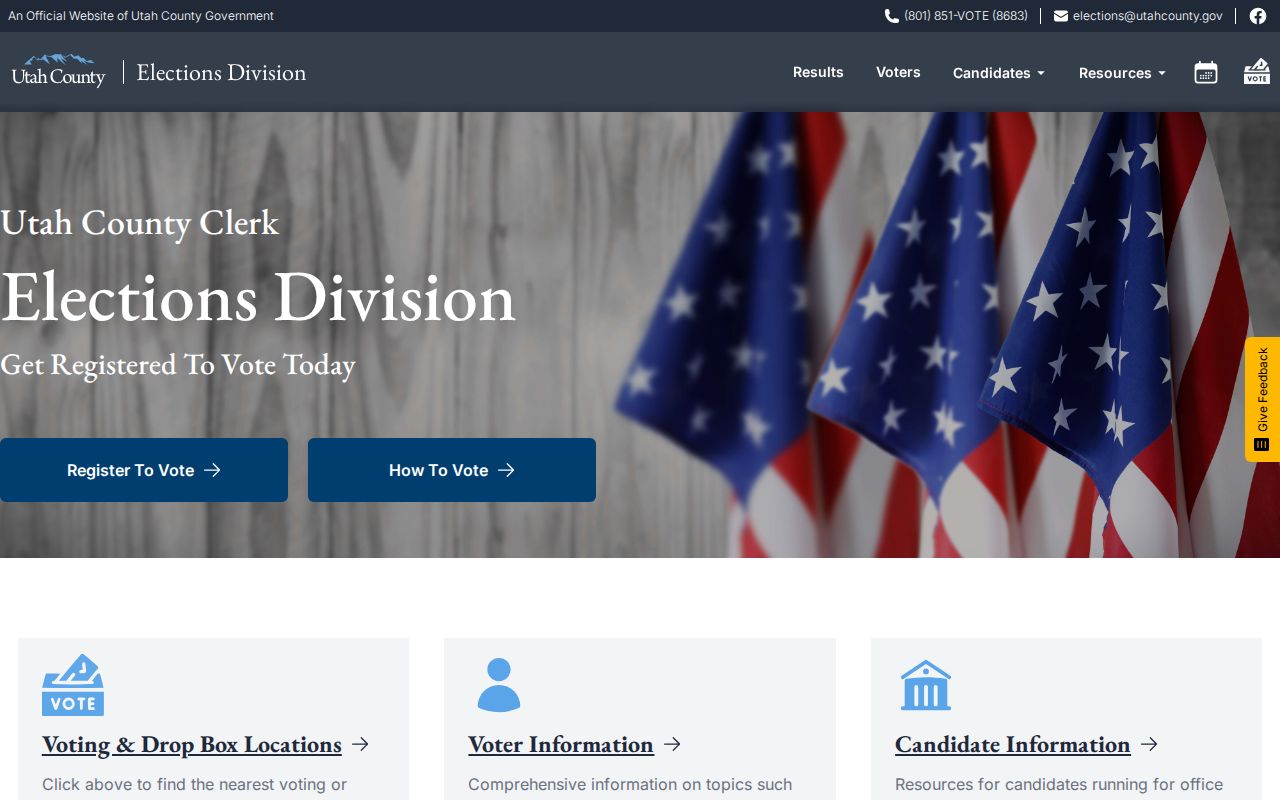
This is the practical fallback when a voter cannot match the portal or needs help with a local precinct, district, address, or invoice.
State and local roles differ. The county administers local registration and elections. The Lieutenant Governor's elections office governs the statewide request route and statutory conditions. A generic Provo public records request does not replace the signed Part 6 certification required for voter data.
Obtain Utah Voter Records
The statewide file is obtained through the Utah voter and election data request, not through the personal lookup. A requester must state a use allowed by §20A-2-607, verify whether the request is on the person's own behalf or through an authorized agent, and accept safeguards against unauthorized access or reposting. The custodian may deny a request when there is probable cause to doubt the identity, authority, or lawful purpose.
- Give the requesting person's name, address, and phone. Add the agent's details when someone acts under authorization.
- Declare the capacity and intended purpose. The purpose must be political, expressly allowed by Part 6, authorized by another law, or ordered by a court.
- Sign the compliance promise and penalty warning. Limit access, keep the data secure, and do not repost it.
- Pay the $1,050 one-time statewide fee. The delivery is tab-delimited and includes no free update subscription.
Utah County has described voter-list, vote-history, and precinct-district CSV output after invoice and payment, usually within two business days. It also posts a $35-per-election nightly has-voted subscription. That county page predates the 2026 overhaul, so use it only to understand the posted channel and output until the county confirms current terms. The current statute makes general voter fees uniform. A tab-delimited statewide file may exceed ordinary spreadsheet capacity, so plan a secure import. No verified current county general-file fee table or downloadable general request form was found.
The official state voter-data request page shows the present acquisition route for Provo voter records.
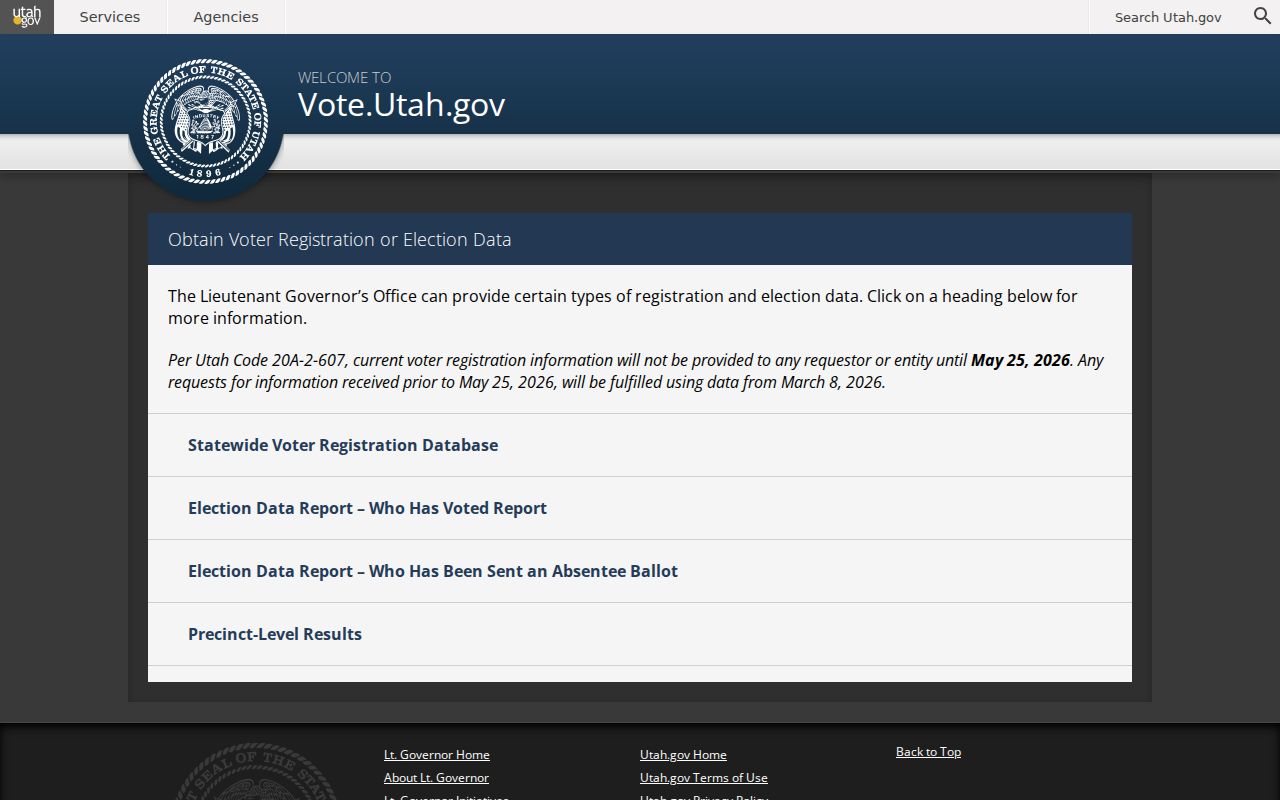
The request is a controlled transfer, not an open download. Part 6 disclosures must be logged and made available no later than one business day after receipt, but that timing does not compel approval of an unlawful request.
Provo Voter Record Misuse
Utah limits both why voter records may be obtained and what happens after delivery. False pretenses, use outside the declared purpose, public or online posting, and unauthorized disclosure violate §20A-2-607. Each can be a class A misdemeanor. A false statement in the request may also fall under Utah Code §76-8-504.
Use voter data lawfully. Public availability never permits stalking, threats, impersonation, or harassment, and a disclosed voter file must stay within its certified purpose and security limits.
Utah's stalking law, §76-5-106.5, covers a two-or-more-act course involving electronic or computer communications when the actor knows or is reckless about causing reasonable fear or emotional distress. Never test whether a person has at-risk protection by trying to expose a suspected survivor's address. Refer suspected voter-data misuse to the Lieutenant Governor's Elections office, Utah County Clerk, or law enforcement.
Historical Provo Voter Registers
Current portals are poor substitutes for old poll books and voter registers. No official Utah County historical series with confirmed Provo coverage years could be verified. Coverage therefore remains unknown. Assigning a first year from general county history would create a false claim about records that may not survive or may be cataloged under another office name.
For historical voter registration work, ask the Utah County Clerk and the Utah State Archives for a named series, creating agency, exact dates, format, and access terms. Search the Archives catalog, then use its reference staff or reading room when an item is not online. Provo became Utah County's seat during an early period of local government, but that fact alone does not prove a poll-book run.
Pair any register entry with a second dated source, such as a city directory, deed, probate file, newspaper, or cemetery record. That confirms the right person and prevents a current address or status from being projected backward onto someone who lived in Provo decades earlier.
Note: Historical register coverage must be verified series by series with the clerk or Archives before citing a year or claiming completeness.